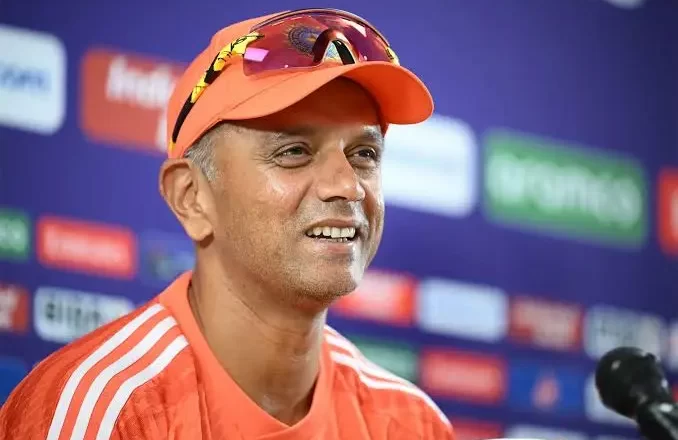

Rahul Sharad Dravid
is an Indian former cricket player who captained and head-coached the Indian national cricket team. Known for his outstanding batting technique, Dravid scored 24,177 runs in international cricket and is widely regarded as one of the greatest batsmen in the history of cricket.
Prior to his appointment to the senior men’s national team, Dravid was the Head of Cricket at the National Cricket Academy (NCA), and the head coach of the India Under-19 and India A teams. Under his tutelage, the Under-19 team finished as runners-up at the 2016 Under-19 Cricket World Cup and won the 2018 Under-19 Cricket World Cup. Under his coaching, Indian cricket team finished as runners-up at the 2023 Cricket World Cup and 2023 ICC World Test Championship final and were semifinalist at the 2022 ICC Men’s T20 World Cup.
Dravid was named one of the Wisden Cricketers of the Year by Wisden Cricketers’ Almanack in 2000 and received the Player of the Year and the Test Player of the Year awards at the inaugural ICC awards ceremony in 2004.[9][10] In December 2011, he was the first non-Australian cricketer to deliver the Bradman Oration in Canberra.[11] As of May 2026, he is the fifth-highest run scorer in Test cricket,[12] and was the first player to score a century in all ten Test-playing countries (now 12).[13] He holds the records for the most balls faced in Test cricket and the longest time spent batting in Tests.[14]
David retired from One Day International and Twenty20 International cricket in August 2011, and from Test and first-class cricket the following year.[15] In July 2018, he became the fifth Indian cricketer to be inducted into the ICC Hall of Fame.[16]
Early life and education
Dravid was born to a Marathi-speaking Brahmin family[17] in Indore, Madhya Pradesh.[18] His family later moved to Bangalore, Karnataka, where he was raised.[19] His mother tongue is Marathi.[20] Dravid’s father, Sharad Dravid, worked for a company that produces jams and preserves, giving rise to the later nickname Jammy. His mother, Pushpa, was a professor of architecture at the University Visvesvaraya College of Engineering in Bangalore.[21] Dravid has a younger brother named Vijay.[22]
Rahul Dravid attended St. Joseph’s Boys High School and earned a degree in commerce from St Joseph’s College of Commerce.[22] He was selected to India’s national cricket team while working towards an MBA at the St Joseph’s College of Business Administration.[23] He is fluent in Marathi, Kannada, English and Hindi.[17]
Formative years and domestic career
Dravid started playing cricket at the age of 12 and represented Karnataka at the under-15, the under-17, and the under-19 levels.[24] Former cricketer Keki Tarapore first noticed Dravid’s talent while coaching at a summer camp in the Chinnaswamy Stadium.[25] Dravid scored a century for his school team.[citation needed] He also played as wicket-keeper.[22]
Dravid made his Ranji Trophy debut in February 1991, while still attending college.[26] Playing alongside future India teammates Anil Kumble and Javagal Srinath against Maharashtra in Pune, he scored 82 runs in the match, which ended in a draw.[27] He followed it up with a century against Bengal and three successive centuries after.[28] Dravid’s first full season took place in 1991–92, when he scored two centuries and finished up with 380 runs at an average of 63.30,[29] resulting in his selection to the South Zone cricket team in the Duleep Trophy.[30] Dravid caught the national team selectors’ attention with his positive performances for India A in the home series against England A in 1994–95.[28]
International career
Debut
Dravid received his first call to the Indian national cricket team in October 1994 for the last two matches of the Wills World Series. However, he could not break into the playing eleven and had to return to the domestic circuit.[31] Despite a stellar show in domestic cricket, Dravid was not selected for the Indian team for the 1996 World Cup, prompting an Indian daily to run an article with the headline – “Rahul Dravid gets a raw deal”.[32]
He eventually made his international debut on 3 April 1996 in an ODI against Sri Lanka in the Singer Cup held in Singapore immediately after the 1996 World Cup, replacing Vinod Kambli.[33][34] He wasn’t particularly successful with the bat, scoring only three runs before being dismissed by Muttiah Muralitharan, but took two catches in the match.[35] He followed it up with another failure in the next game, scoring only four runs before being run out against Pakistan.[35]
In contrast to his ODI debut, his Test debut was rather successful. He was selected for the Indian squad touring England on the backdrop of a consistent performance in domestic cricket for five years.[31][36] Fine performances in the tour games including fifties against Gloucestershire and Leicestershire failed to earn him a place in the team for the First Test.[37] He finally made his Test debut at Lord’s on 20 June 1996 against England in the Second Test of the series at the expense of injured senior batsman Sanjay Manjrekar.[33][38] Manjrekar, who was suffering from an ankle injury, was to undergo a fitness test on the morning of the Second Test. Dravid had already been informed that he would play if Manjrekar failed the test. Manjrekar subsequently failed the test. Ten minutes before the toss, team coach Sandeep Patil informed Dravid that he was indeed going to make his debut that day. Patil recalled years later:[38]
I told him he will be playing. His face lit up. I cannot forget that moment.
Coming in to bat at no. 7, he forged important partnerships, first with another debutant Sourav Ganguly and then with Indian lower order, securing a vital first innings lead for his team.[39][40] Dravid scored 95 runs missing out on a debut hundred as he walked off after getting caught behind to a Chris Lewis delivery.[41] During this match, he also took his first catch in Test cricket to dismiss Nasser Hussain off the bowling of Srinath.[42][43] In the next tour game against British Universities, Dravid scored a hundred. He scored another fifty in the first innings of the Third Test.[35] Dravid concluded a successful debut series with an average of 62.33 from two Test matches.[44]
I had played five years of first-class cricket to break into the Indian team … scored a lot of runs in domestic cricket … was lucky to get the opportunity … knew that probably it would be the only one. Otherwise I would have to go back to domestic cricket and start the cycle all over again … I remember when I was 50 not out at the end of the day … walking back to the hotel with Srinath and I knew somehow that this was probably a very significant innings. I knew I had some more breathing space … a few more Test matches at least … gave me a lot of confidence scoring 95 here and 80 at Trent Bridge … as a player and as a person.
1996–98: Early years
Dravid’s early years in international cricket mirrored his international debut. He had contrasting fortunes in the long and the shorter format of the game. While he was successful in Test cricket, he struggled with ODIs.[46]
After his Test debut in England, Dravid played in the one-off Test against Australia in Delhi – his first Test in India. Batting at no. 6, he scored 40 runs in the first innings. Dravid batted at no. 3 position for the first time in the First Test of the three-match home series against South Africa in Ahmedabad in November 1996.[39] He failed to perform well in the series, scoring only 175 runs at an average of 29.16.[44]